These were the suggested uses I came up with and fed back to the delegates after each of the formats were discussed:
Company website or Intranet
Sorts of Content
Company Information and strategy
Training Strategy
Department Structure
Trainer Profiles
Training Courses Outline
How to Book
Course Dates
Advantages
Can raise the profile of your training department
Learners can access content easily
Disadvantages
May need training in using a content management software
Top down – People cannot contribute content
Discussion Forum
Sort of Content
Anything goes! Depends on how the forum is promoted
Whatever users want to discuss or ask questions about
Mostly all User generated content
Advantages
Social dimension for networking and building relationships
Specific answers to specific problems
Very Interactive
Sharing Knowledge
Disadvantages
Requires moderation to delete spam or inappropriate content
Answers may not be correct
Not always easy to find specific content
Blog
Sort of content
Journal entries (opinion & comment)
Maybe some training materials, if indexed correctly with tags
Advantages
Very easy to set up and Publish to
Interesting – personal emotional content
Flexible either Individual or set up as a Network so many users can post
Interactive – Readers can comment,
Disadvantages
Content is published chronologically on a journal format. Older content not so accessible
Cannot upload documents, can Copy & Paste content
Wiki
Sort of content
Documents in any format eg Word, pdf
Anyone with an account can contribute or edit content eg Wikipedia
Advantages
Saves emailing large attachments, just send the link
Democratic, anyone can contribute knowledge
Enables sharing of best practice
Central resource for Information
Documents and content to support face to face training
Disadvantages
Relies on regular contributions and updates
Showing posts with label CTP. Show all posts
Showing posts with label CTP. Show all posts
Monday, 2 June 2008

Group Feedback from Exercise
The group were asked to think about using the following online resources.
The 4 formats were divided between the groups.
They were asked to consider how they could use:
- Their company website
- Discussion Forum
- Blog
- Wiki

The 4 formats were divided between the groups.
They were asked to consider how they could use:
- Their company website
- Discussion Forum
- Blog
- Wiki
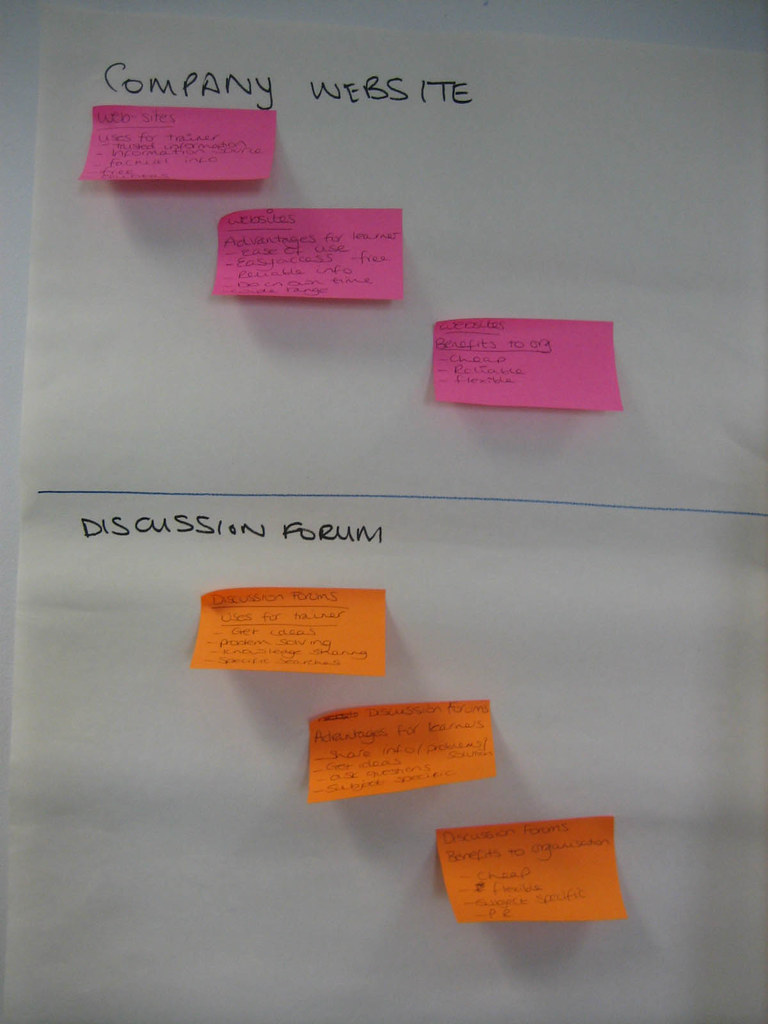
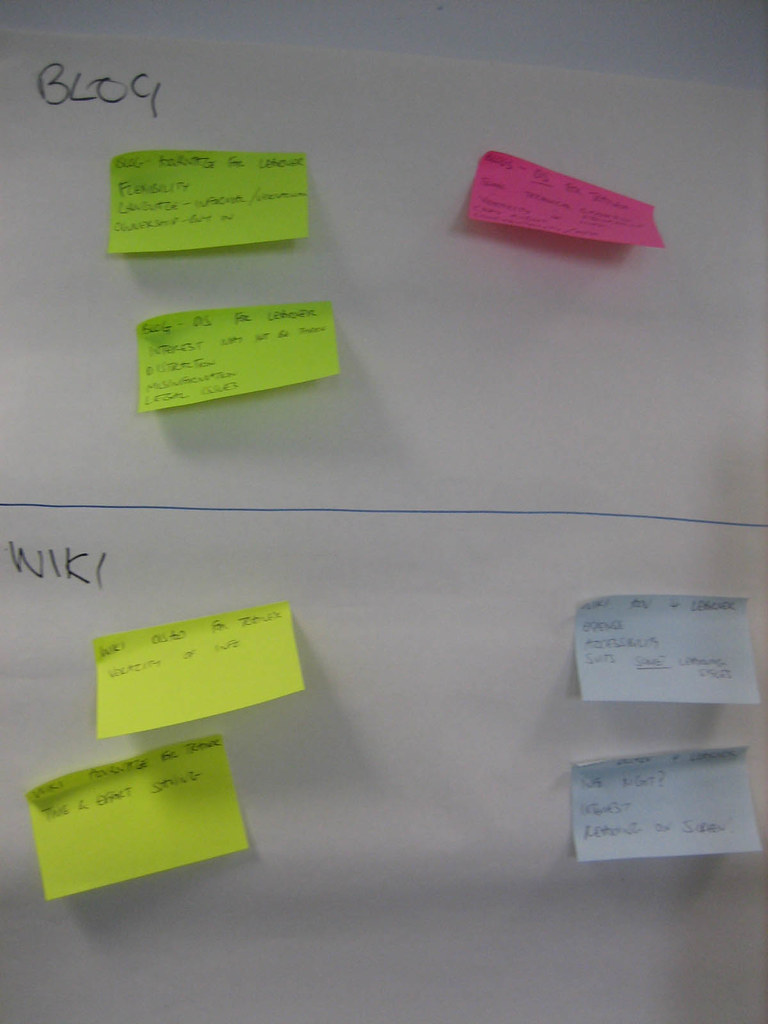
Having been provided with definition and examples of all the above and the group confirming that they understood groups were asked to consider each format and come up with some ideas on:
• Uses for the Trainer
• Advantages for the Learner
• Benefits for the organisation
Consider ease of use, access, skills required and type of content you could publish
Results from the Post It exercise by format.
All Information below was from the delegates:
Company Website
Uses for a trainer
Trusted information source
Factual information
Free
Quotes
Benefits for a Learner
Ease of use
Easy access, free
Reliable information
Can do in own time
Wide range
Benefits to the Organisation
Cheap
Reliable
Flexible
Discussion Forum
Uses for a trainer
Get ideas
Problem solving
Knowledge sharing
Specific searches
Benefits for a Learner
Share information, problems, solutions
Get ideas
Ask questions
Subject specific
Benefits to the Organisation
Cheap
Flexible
Subject specific
Blog
Uses for a trainer
(NONE)
Issues
Some technical knowledge required
Veracity of information
Copyright
Confidentiality DPA
Benefits for a Learner
Flexibility
Language Informal/ vernacular
Ownership buy in
Benefits to the Organisation
(NONE)
Wiki
Uses for a trainer
Time and effort saving
Veracity of info
Benefits for a Learner
Acessibility
Suits some learning styles
Is the information correct?
Interest
Reading on screen
Benefits to the Organisation
(NONE)
Friday, 16 May 2008
CTP Notes 15th May
Working on the Appropriateness exercise – HR manager, etc.
When do we feedback to learners?
Before assessment, after tasks, all the time, in reviews, appraisals, etc.
PP What is the purpose of this feedback?
Praise sandwich
· Praise
· Highlight areas for development
· Gain agreement on how to improve
· Praise
Specific
Actionable
When do we feedback to learners?
Before assessment, after tasks, all the time, in reviews, appraisals, etc.
PP What is the purpose of this feedback?
Praise sandwich
· Praise
· Highlight areas for development
· Gain agreement on how to improve
· Praise
Specific
Actionable
CTP Notes 8th May
“How do we communicate?”
Professionally – correct terminology, no swearing
Body Language – open and accessible
Verbally – speech
With props / tools – appropriate and arranged before the session
Written – if on flip chart readable
Questions – should be answerable
Tactfully – if the delegates don’t really get it
Visually – should be clear
Timely – Too late is no good
Priming – nudging the delegates to come up with their own answers
What “noise” prevents messages being acted upon?
Methodology / Questioning technique
Not clear instructions
Personality clashes
Distractions / environment
Resources
Interaction of the delegates with each other
Contradictory beliefs
Language
Equality and diversity.
We watched the video from the previous week and commented on each other’s body language and ability to engage with their delegates.
Professionally – correct terminology, no swearing
Body Language – open and accessible
Verbally – speech
With props / tools – appropriate and arranged before the session
Written – if on flip chart readable
Questions – should be answerable
Tactfully – if the delegates don’t really get it
Visually – should be clear
Timely – Too late is no good
Priming – nudging the delegates to come up with their own answers
What “noise” prevents messages being acted upon?
Methodology / Questioning technique
Not clear instructions
Personality clashes
Distractions / environment
Resources
Interaction of the delegates with each other
Contradictory beliefs
Language
Equality and diversity.
We watched the video from the previous week and commented on each other’s body language and ability to engage with their delegates.
CTP Notes 1st May
“Why do we ask questions in a training session?”
a) to enable the delegates to demonstrate evidence of understanding
b) to retain control
c) to engage the delegates
d) to create discussion
e) clarification / elaboration for others
f) fun
g) to encourage sharing of experience
h) to signpost the end of a subject
i) to challenge the delegates
j) to keep delegates awake
k) to buy yourself some time
Notes from seminar at the HRD session. This speaker promised he would ensure that we would never again ask a question that had a tumbleweed response (ie no response). The trick is the
O_ _ T_ _ F _ _ _ _ method – up on the flipchart. One two free
First, give delegates 30 seconds to work out what might be missing from the words. Then 30 seconds discussing it with the person next to them. After this when the answer is requested by the trainer there will always be something shouted out. This encapsulates stages 6 and 7 listed below.
He talked about the 7 stages of learning intelligence Gardner (1983) identified different types of learning,
particularly those characterised as ‘know-how’ and ‘know that’. From that he defined ‘multiple intelligences’, to describe the different ways (and combinations of ways) in which individuals learn. Learning can be seen as ‘playing’
different capabilities:
1. the verbal/linguistic; literally how the message is delivered verbally or written
2. logical/mathematical; making the message relevant to the learner (purpose)
3. visual/spatial; colour, charts, games, information delivered visually arrestingly
4. musical/rhythmic; music can help learners concentrate / forget themselves
5. bodily/kinesthetic; literally get the delegates off their feet and moving around
6. social/interpersonal discuss messages with the group / partner
7. personal/intrapersonal. Think about it oneself, mull it over
The theory of multiple intelligences was developed in 1983 by Dr. Howard Gardner, professor of education at Harvard University. It suggests that the traditional notion of intelligence, based on I.Q. testing, is far too limited. Instead, Dr. Gardner proposes eight different intelligences to account for a broader range of human potential in children and adults. These intelligences are:
bullet Linguistic intelligence ("word smart"):
bullet Logical-mathematical intelligence ("number/reasoning smart")
bullet Spatial intelligence ("picture smart")
bullet Bodily-Kinesthetic intelligence ("body smart")
bullet Musical intelligence ("music smart")
bullet Interpersonal intelligence ("people smart")
bullet Intrapersonal intelligence ("self smart")
bullet Naturalist intelligence ("nature smart")
http://www.thomasarmstrong.com/multiple_intelligences.htm
What does this tell us?. Questioning is usually designed to gather information. Not for a trainer, who should be far more like a barrister. If the trainer asks a question that could have an unhelpful response, or to which he / she does not know the answer, don’t ask it.
Groups were allocated and each had to design either a case study or a discussion session to assess how well we asked questions and dealt with the responses. This was videoed!!
Group 1 – CB, DM, SG & LR did an environmental Q & A session.
CB started off by saying that everyone in the room could have an impact on saving the world. Then passed on to Dimple who discussed re-cycling, who passed onto CB who talked about transport (immediately proving Jane P’s point about asking daft questions and then persuing poor Liz for a response to a point she had no opinion or knowledge of), who then passed on to Sonia who talked about energy saving and finally Laura who talked about plastic bags. Finally CB rounded up with a question for each delegate.
The other 2 groups did something similar – one with contemporary versus older music and one about telephone skills.
a) to enable the delegates to demonstrate evidence of understanding
b) to retain control
c) to engage the delegates
d) to create discussion
e) clarification / elaboration for others
f) fun
g) to encourage sharing of experience
h) to signpost the end of a subject
i) to challenge the delegates
j) to keep delegates awake
k) to buy yourself some time
Notes from seminar at the HRD session. This speaker promised he would ensure that we would never again ask a question that had a tumbleweed response (ie no response). The trick is the
O_ _ T_ _ F _ _ _ _ method – up on the flipchart. One two free
First, give delegates 30 seconds to work out what might be missing from the words. Then 30 seconds discussing it with the person next to them. After this when the answer is requested by the trainer there will always be something shouted out. This encapsulates stages 6 and 7 listed below.
He talked about the 7 stages of learning intelligence Gardner (1983) identified different types of learning,
particularly those characterised as ‘know-how’ and ‘know that’. From that he defined ‘multiple intelligences’, to describe the different ways (and combinations of ways) in which individuals learn. Learning can be seen as ‘playing’
different capabilities:
1. the verbal/linguistic; literally how the message is delivered verbally or written
2. logical/mathematical; making the message relevant to the learner (purpose)
3. visual/spatial; colour, charts, games, information delivered visually arrestingly
4. musical/rhythmic; music can help learners concentrate / forget themselves
5. bodily/kinesthetic; literally get the delegates off their feet and moving around
6. social/interpersonal discuss messages with the group / partner
7. personal/intrapersonal. Think about it oneself, mull it over
The theory of multiple intelligences was developed in 1983 by Dr. Howard Gardner, professor of education at Harvard University. It suggests that the traditional notion of intelligence, based on I.Q. testing, is far too limited. Instead, Dr. Gardner proposes eight different intelligences to account for a broader range of human potential in children and adults. These intelligences are:
bullet Linguistic intelligence ("word smart"):
bullet Logical-mathematical intelligence ("number/reasoning smart")
bullet Spatial intelligence ("picture smart")
bullet Bodily-Kinesthetic intelligence ("body smart")
bullet Musical intelligence ("music smart")
bullet Interpersonal intelligence ("people smart")
bullet Intrapersonal intelligence ("self smart")
bullet Naturalist intelligence ("nature smart")
http://www.thomasarmstrong.com/multiple_intelligences.htm
What does this tell us?. Questioning is usually designed to gather information. Not for a trainer, who should be far more like a barrister. If the trainer asks a question that could have an unhelpful response, or to which he / she does not know the answer, don’t ask it.
Groups were allocated and each had to design either a case study or a discussion session to assess how well we asked questions and dealt with the responses. This was videoed!!
Group 1 – CB, DM, SG & LR did an environmental Q & A session.
CB started off by saying that everyone in the room could have an impact on saving the world. Then passed on to Dimple who discussed re-cycling, who passed onto CB who talked about transport (immediately proving Jane P’s point about asking daft questions and then persuing poor Liz for a response to a point she had no opinion or knowledge of), who then passed on to Sonia who talked about energy saving and finally Laura who talked about plastic bags. Finally CB rounded up with a question for each delegate.
The other 2 groups did something similar – one with contemporary versus older music and one about telephone skills.
CTP Notes 13th March
Last week we finished talking about Bloom – Psychomotor, Social and Behavioural.
Bloom is saying that when training courses are put together is this skills, knowledge or attitude based?
Psychomotor – Physical Skills
Cognitive – Knowledge and knowing
Affective – Feelings and emotions
Skills at the bottom are low order tasks. We remember information crammed for an exam for a short time then probably not after the exam.
Skills at the top of the list are where we construct our own meanings (and take it away with us and put it into practice).
Jabberwocky exercise.
1. Gyre and Gimble
2. Mimsy
3. They outgrabe
4. No
5. Because of how they appeared / moved about? You can’t tell
6. Totally baffled
Where are these questions in relation to Bloom’s scale?
Levels (cognitive domain)
1-3 knowledge = lowest level
5. Analysis (before you can make analysis you have to understand)
6. Evaluation
Surface – simple parrot-fashion
Deep – Assimilation of info and use oneself
Learning Objectives
¨ What is the purpose of a learning objective?
¨ When should objectives be used?
Why have learning objectives?
Liz – so you can test whether the delegates’ have learnt it.
When should the objectives be outlined?
At the beginning
Aim
¨ A general statement of the purpose of the course
Objectives
¨ A statement in words of the intended learning outcome of a learning event which states what the trainee will be able to do as a result of the training
¨ A specific statement of what will be delivered
¨ Objectives must be SMART
Handout – Guidelines for defining Objectives
Approaches
¨ Trainer-centred
Trainer facilitating and leading session
¨ Learner centred
Learning at one’s own speed / distance
Trainer centred where the focus is on the trainer dictating the pace and content.
Bloom is saying that when training courses are put together is this skills, knowledge or attitude based?
Psychomotor – Physical Skills
Cognitive – Knowledge and knowing
Affective – Feelings and emotions
Skills at the bottom are low order tasks. We remember information crammed for an exam for a short time then probably not after the exam.
Skills at the top of the list are where we construct our own meanings (and take it away with us and put it into practice).
Jabberwocky exercise.
1. Gyre and Gimble
2. Mimsy
3. They outgrabe
4. No
5. Because of how they appeared / moved about? You can’t tell
6. Totally baffled
Where are these questions in relation to Bloom’s scale?
Levels (cognitive domain)
1-3 knowledge = lowest level
5. Analysis (before you can make analysis you have to understand)
6. Evaluation
Surface – simple parrot-fashion
Deep – Assimilation of info and use oneself
Learning Objectives
¨ What is the purpose of a learning objective?
¨ When should objectives be used?
Why have learning objectives?
Liz – so you can test whether the delegates’ have learnt it.
When should the objectives be outlined?
At the beginning
Aim
¨ A general statement of the purpose of the course
Objectives
¨ A statement in words of the intended learning outcome of a learning event which states what the trainee will be able to do as a result of the training
¨ A specific statement of what will be delivered
¨ Objectives must be SMART
Handout – Guidelines for defining Objectives
Approaches
¨ Trainer-centred
Trainer facilitating and leading session
¨ Learner centred
Learning at one’s own speed / distance
Trainer centred where the focus is on the trainer dictating the pace and content.
CTP Notes 6th March
Theoretical approaches to Learning
Given 3 x handouts – Social, cognitive and behaviourist learning
Training we’ve hosted or attended. Which methods have we used / witnessed? Which worked?
Social Learning – role plays with feedback. The learner cannot rely solely on their own actions, their peers / tutor has a big impact. Negative experience of long multiplication horror when I was 8 years old.
Cognitive – lots of the cargiant sessions are like this – too cognitive at the expense of other methods – too theoretical
Behaviourist – Al of us here at Ux are examples of behaviourist learning. It’s a means to an end – a reward.
Outstanding retention of learning handout. Fascinating.
Pyramid handout – Domains of learning.
Psychomotor
Cogntive - Bloom
Affective
What methods do you use when you put together training?
Think of the delegates’ personalities / level of expertise
Make message clear
What’s the desired Learning Outcome
Environment
Resources - £, time, equipment, venue
Mix up the modes of delivery
How can we measure success
How can we know what level reached
Decide which method most effective to deliver particular message
Given 3 x handouts – Social, cognitive and behaviourist learning
Training we’ve hosted or attended. Which methods have we used / witnessed? Which worked?
Social Learning – role plays with feedback. The learner cannot rely solely on their own actions, their peers / tutor has a big impact. Negative experience of long multiplication horror when I was 8 years old.
Cognitive – lots of the cargiant sessions are like this – too cognitive at the expense of other methods – too theoretical
Behaviourist – Al of us here at Ux are examples of behaviourist learning. It’s a means to an end – a reward.
Outstanding retention of learning handout. Fascinating.
Pyramid handout – Domains of learning.
Psychomotor
Cogntive - Bloom
Affective
What methods do you use when you put together training?
Think of the delegates’ personalities / level of expertise
Make message clear
What’s the desired Learning Outcome
Environment
Resources - £, time, equipment, venue
Mix up the modes of delivery
How can we measure success
How can we know what level reached
Decide which method most effective to deliver particular message
CTP Notes 8th February
Job analysis
We split into groups (CB, SB and JB – the B team) with Sonia asking Jo, Jo asking CB and CB asking SB questions we devised to question 1 from the handout entitled “Certificate in Training Practice Job Analysis”.
This is not about the individual’s abilities, but about the job role itself.
Question 1 from the handout
Devise questions for a job analysis
1. What does you job entail?
2. What % do you spend you time
3. How much course design do you do?
4. What’s your job title?
5. To whom do you report?
6. What is the nature of the business?
7. How is the success of your courses measured?
8. What is the level of expertise / ability of your delegates?
9. What special considerations do you need to take into account on behalf of your learners?
10. How do delegates access your training?
11. How many staff report into you?
12. What knowledge is needed prior to being offered the role?
13. Do you procure external companies to provide training?
Question 2 from the handout
Questions that could be asked of the manager employing the worker in the questions above.
1. What do you expect this person to achieve in this position?
2. What qualifications / experience does this person have to have?
3. What responsibilities does this position include?
4. How often do the trainers report to the MD?
Question 3 from the handout
What other methods could you use?
Observation, talk to competitors, CCTV, Mystery Shopping, Ask subject to keep a work diary.
}
From this, then list tasks into the table we were handed – task / knowledge / skills
Or table
key tasks / key competencies / standards and measuresPP slide
Job Analysis Methods
Observation
Interviews
Focus Groups
Questionnaires
Work Diaries
Example
1. Task analysis suggested that to do the job excel spreadsheets need to be compiled and submitted to a specific deadline.
2. Knowledge required – access to company data and the layout of the spreadsheets required
3. Skill required – use of excel up to sufficient standard
4. Assessment of a particular employee did not provide evidence of excel expertise up to the sufficient standard.
5. Recommendation is to send this employee on an excel training course in order to improve these skills.
6. Justification is that because deadlines are being missed due to this inexpertise training expense is justified.
We split into groups (CB, SB and JB – the B team) with Sonia asking Jo, Jo asking CB and CB asking SB questions we devised to question 1 from the handout entitled “Certificate in Training Practice Job Analysis”.
This is not about the individual’s abilities, but about the job role itself.
Question 1 from the handout
Devise questions for a job analysis
1. What does you job entail?
2. What % do you spend you time
3. How much course design do you do?
4. What’s your job title?
5. To whom do you report?
6. What is the nature of the business?
7. How is the success of your courses measured?
8. What is the level of expertise / ability of your delegates?
9. What special considerations do you need to take into account on behalf of your learners?
10. How do delegates access your training?
11. How many staff report into you?
12. What knowledge is needed prior to being offered the role?
13. Do you procure external companies to provide training?
Question 2 from the handout
Questions that could be asked of the manager employing the worker in the questions above.
1. What do you expect this person to achieve in this position?
2. What qualifications / experience does this person have to have?
3. What responsibilities does this position include?
4. How often do the trainers report to the MD?
Question 3 from the handout
What other methods could you use?
Observation, talk to competitors, CCTV, Mystery Shopping, Ask subject to keep a work diary.
}
From this, then list tasks into the table we were handed – task / knowledge / skills
Or table
key tasks / key competencies / standards and measuresPP slide
Job Analysis Methods
Observation
Interviews
Focus Groups
Questionnaires
Work Diaries
Example
1. Task analysis suggested that to do the job excel spreadsheets need to be compiled and submitted to a specific deadline.
2. Knowledge required – access to company data and the layout of the spreadsheets required
3. Skill required – use of excel up to sufficient standard
4. Assessment of a particular employee did not provide evidence of excel expertise up to the sufficient standard.
5. Recommendation is to send this employee on an excel training course in order to improve these skills.
6. Justification is that because deadlines are being missed due to this inexpertise training expense is justified.
CTP Notes 31st January
CB, SB, LP, JL and VM presented “What is e-learning and blended learning?” Liz accessed the outstanding BBC website e-learning facility on the Smartboard©.
JH, JB, LR, WJ and NK presented “Advantages of e-learning.”
SG, DM, JB and CG presented “Disadvantages of e-learning.”
Transfer of learning was what we covered last week. E-learning has one strength as all of the results are recorded as evidence. H & S, PC skills are 2 topics that lend themselves to e-learning.
“It’s all down to the organisation’s needs and resources.”
Now we concentrate on the bits that will contribute to the assignment 2.
We need to do a learning needs assessment. “We’re getting away from the word “training” in favour of “learning” now.
Learning Needs Analysis – role rather than individual
Skills – competency-based
Then assess the individual and find the gap(s) in their ability.
How would we assess our own Learning Needs?
1. Job Description
2. Managers’ feedback
3. Annual Appraisal
4. Self-assessment / psychometric testing
5. Key Performance Indicators – results of training
6. Networking / comparing with peers
7. Awareness of industry / technology used in field
8. Legal, employment standards / Qualifications
9. Business Strategy
10. Mistakes
7.55pm CB put on projector CG “stonking performance”
From PP slide
¨ Appraisal
¨ Performance data
¨ Observation
¨ Interviews
¨
We should consider these means for our AssignmentQuestionnaires
¨ Work sample tests
¨ Diaries
¨ Devised situations, ie role plays
¨ Peer / manager diagnostic ratings
¨ Development centres
(like assessment centres, but no job at the end)
¨ Self-assessment
¨ Psychometric tests
SB emailing CB Moodle info. SB..?
JP very disconcerted that we didn’t seem to remember what we’d covered on the 10th Jan about organisational needs.
Today we’re taking up from where we were before Christmas, Levels of need analysis. We will also have 1-2-1s to discuss proposals and date of workshops which will be marked assignments 2 and 3.
Organisation
Job / Group
Individual
Boydell & Leary handout 1”
Organisations have Business Strategy – for example Uxbridge College is having an Ofsted Inspection. Its Business Strategy may be to gain a Grade 2 which is a promotion from a Grade 3.
Job needs will bring about the testing for the individual.
The assessment for our peer needs to have evidence of job analysis.
PP slide
Job Analysis
“The process of collecting, analysing and setting out information about the contents of jobs in order to provide the basis for a job description and data for recruitment, training and performance management”
“How do you find out what a Tesco’s cashier is supposed to do?”
Speak to manager, observe…
A Job analysis should come first, then the job description can be designed.
What information should you obtain from a job analysis?
What type of information do you want to find out?
¨ Contect and activities of the job
¨ The output(s) of the job
¨ The skills, knowledge and attributes required for the job
¨ How the job is performed
- What should they be doing?
Individual needs not a concern until that person is monitored for themselves.
Assignment 2
Stage 1 – For your 2 peers you are to do a job analysis. This will find out what they are supposed to do.
Stage 2 – Assessing whether they have the skills to do the job – individual needs analysis.
JH, JB, LR, WJ and NK presented “Advantages of e-learning.”
SG, DM, JB and CG presented “Disadvantages of e-learning.”
Transfer of learning was what we covered last week. E-learning has one strength as all of the results are recorded as evidence. H & S, PC skills are 2 topics that lend themselves to e-learning.
“It’s all down to the organisation’s needs and resources.”
Now we concentrate on the bits that will contribute to the assignment 2.
We need to do a learning needs assessment. “We’re getting away from the word “training” in favour of “learning” now.
Learning Needs Analysis – role rather than individual
Skills – competency-based
Then assess the individual and find the gap(s) in their ability.
How would we assess our own Learning Needs?
1. Job Description
2. Managers’ feedback
3. Annual Appraisal
4. Self-assessment / psychometric testing
5. Key Performance Indicators – results of training
6. Networking / comparing with peers
7. Awareness of industry / technology used in field
8. Legal, employment standards / Qualifications
9. Business Strategy
10. Mistakes
7.55pm CB put on projector CG “stonking performance”
From PP slide
¨ Appraisal
¨ Performance data
¨ Observation
¨ Interviews
¨
We should consider these means for our AssignmentQuestionnaires
¨ Work sample tests
¨ Diaries
¨ Devised situations, ie role plays
¨ Peer / manager diagnostic ratings
¨ Development centres
(like assessment centres, but no job at the end)
¨ Self-assessment
¨ Psychometric tests
SB emailing CB Moodle info. SB..?
JP very disconcerted that we didn’t seem to remember what we’d covered on the 10th Jan about organisational needs.
Today we’re taking up from where we were before Christmas, Levels of need analysis. We will also have 1-2-1s to discuss proposals and date of workshops which will be marked assignments 2 and 3.
Organisation
Job / Group
Individual
Boydell & Leary handout 1”
Organisations have Business Strategy – for example Uxbridge College is having an Ofsted Inspection. Its Business Strategy may be to gain a Grade 2 which is a promotion from a Grade 3.
Job needs will bring about the testing for the individual.
The assessment for our peer needs to have evidence of job analysis.
PP slide
Job Analysis
“The process of collecting, analysing and setting out information about the contents of jobs in order to provide the basis for a job description and data for recruitment, training and performance management”
“How do you find out what a Tesco’s cashier is supposed to do?”
Speak to manager, observe…
A Job analysis should come first, then the job description can be designed.
What information should you obtain from a job analysis?
What type of information do you want to find out?
¨ Contect and activities of the job
¨ The output(s) of the job
¨ The skills, knowledge and attributes required for the job
¨ How the job is performed
- What should they be doing?
Individual needs not a concern until that person is monitored for themselves.
Assignment 2
Stage 1 – For your 2 peers you are to do a job analysis. This will find out what they are supposed to do.
Stage 2 – Assessing whether they have the skills to do the job – individual needs analysis.
CTP Notes 17th January
Learning Opportunities
· On the job (informal)
· Off the job (formal)
“we’re leaving individual needs analysis for next time.”
Split into 2 groups of 3
Liz, Dimple and Natalie looking at the pros and cons of On the Job Training
Chris, Julie and Sharon looking at the pros and cons of Off the Job Training
Event – Off the Job
Pro
Con
Classroom
One message sent to several / lots of receivers
Time limits, not all learners would respond to that kind of environment
Team Building
Opportunity for bonding outside the usual location / working time
Cost, time, outcomes may not be determinable
Academic ie. CIPD
Formal qualification, chance to meet peers
Cost, time, schedule may be inflexible
Conferences / seminars
One message sent to several / lots of receivers, networking opps
Location may not be accesible, content may not be apt
Knowledge sharing
More specific
Other groups may miss out on this info.
Secondments
Opportunity to be in a different environment, skill transferance
Potential for disruption in the original workplace
Event – On the job
Pro
Con
Shadowing
Happening “live”
Not instructor led
Supervision
Happening “live”
Open to misinterpretation
Observation
Happening “live”
Open to misinterpretation
Desk research (net, etc.)
Wide (unlimited?) source of information
Time constraints
Professional / coaching or mentor
Specific to that trainee
Too low??
Appraisals
Specific to that trainee
Lack of 2 way flow of information
Seminars / Conferences
Face to face
Relevance?
Focus Groups
Fresh networks
Chaotic
Team meetings
Consensus
Timely
E-learning
Self-motivation
Lack of structure
The group made the point that there was seldom a record of this kind of learning – ie training records. They should be recorded.
PP slide Evaluate each method in terms of
· Diversity
· Equality of access for all employees
Event
Diversity (ability)
Equality (language, religion)
Classroom
Not for shiftworkers
Not for those with physical impairments in a location without provision
Team Building
Out of hours may not be able to attend
Physical issues, culture
Academic ie. CIPD
Not every learner is academically inclined
(i.e. Natalie – joke!)
Language constraints
Conferences / seminars
Childcare commitments
Knowledge sharing
Secondments
There may be issues with all of the above in terms of allowing for diversity and equality, I.e the fact that muslim females cannot be in an enclosed space with a male. Special dispensations may need to be considered and put in place to ensure that there could be no cause for complaint and the session would run smoothly.
Exercise
Training Needs Analysis states that waiters have no food hygiene knowledge. 3/10 of the waiters have poor customer service skills and complaints have been made. What now?
Book up basic food hygiene course. This must not interfere with the normal working of the restaurant hours. One course for them all? Two sessions? For the customer service those who were found wanting could buddy up with those who were not.
· On the job (informal)
· Off the job (formal)
“we’re leaving individual needs analysis for next time.”
Split into 2 groups of 3
Liz, Dimple and Natalie looking at the pros and cons of On the Job Training
Chris, Julie and Sharon looking at the pros and cons of Off the Job Training
Event – Off the Job
Pro
Con
Classroom
One message sent to several / lots of receivers
Time limits, not all learners would respond to that kind of environment
Team Building
Opportunity for bonding outside the usual location / working time
Cost, time, outcomes may not be determinable
Academic ie. CIPD
Formal qualification, chance to meet peers
Cost, time, schedule may be inflexible
Conferences / seminars
One message sent to several / lots of receivers, networking opps
Location may not be accesible, content may not be apt
Knowledge sharing
More specific
Other groups may miss out on this info.
Secondments
Opportunity to be in a different environment, skill transferance
Potential for disruption in the original workplace
Event – On the job
Pro
Con
Shadowing
Happening “live”
Not instructor led
Supervision
Happening “live”
Open to misinterpretation
Observation
Happening “live”
Open to misinterpretation
Desk research (net, etc.)
Wide (unlimited?) source of information
Time constraints
Professional / coaching or mentor
Specific to that trainee
Too low??
Appraisals
Specific to that trainee
Lack of 2 way flow of information
Seminars / Conferences
Face to face
Relevance?
Focus Groups
Fresh networks
Chaotic
Team meetings
Consensus
Timely
E-learning
Self-motivation
Lack of structure
The group made the point that there was seldom a record of this kind of learning – ie training records. They should be recorded.
PP slide Evaluate each method in terms of
· Diversity
· Equality of access for all employees
Event
Diversity (ability)
Equality (language, religion)
Classroom
Not for shiftworkers
Not for those with physical impairments in a location without provision
Team Building
Out of hours may not be able to attend
Physical issues, culture
Academic ie. CIPD
Not every learner is academically inclined
(i.e. Natalie – joke!)
Language constraints
Conferences / seminars
Childcare commitments
Knowledge sharing
Secondments
There may be issues with all of the above in terms of allowing for diversity and equality, I.e the fact that muslim females cannot be in an enclosed space with a male. Special dispensations may need to be considered and put in place to ensure that there could be no cause for complaint and the session would run smoothly.
Exercise
Training Needs Analysis states that waiters have no food hygiene knowledge. 3/10 of the waiters have poor customer service skills and complaints have been made. What now?
Book up basic food hygiene course. This must not interfere with the normal working of the restaurant hours. One course for them all? Two sessions? For the customer service those who were found wanting could buddy up with those who were not.
CTP Notes 18th October
Day Six
Organisational Culture
Think about where you worked last and where you now work: in what way do they differ?
Work ethic
Polish (swearing, etc.)
Size of organisation (1 site versus global brand)
Competitiveness of sales people
Drive (no reason to work hard at Tie Rack, whereas commission at cg…)
Rules and regulations (swiping in and out)
Cross-section of delegates (workshop, security, maintenance V retailers).
All the group wrote down one of our examples on the Smartboard.
External V Internal clients
Day to day contact with senior management V no contact with senior management
Innovation V Old School
Policies and procedures
External Training V Internal Training
Structure
Drive (mine)
Victims of 1 crime V victims of multiple crimes ie. nature of customers / clients
Working from home
Casual V Rigid (almost no boundaries set)
Process driven V no processes
Good V Bad Technology
Compassion V Commercialism
Punchline is – they are all to do with culture
Definition of culture
The culture of an organisation is:
The culture of relatively uniform and enduring values, beliefs, customs, traditions and practices that are shared by an organisation’s members and transmitted between generations of employees. Huczynski and Buchanan (2001)
or…
The way we do things around here Currie (2006)
It can also be said to be the personality of the organisation.
Artefacts
Values
Assumptions
Implicit expectations. Far more difficult to define. What employees automatically do without thinking about it. Conditioning? I.e. saying “hello” may be conditioned in or indeed out of an employee’s behaviour.
Explicitly stated aims and objectives, mission statement or vision statement, for profit, not for profit, etc.
Property, logos, livery, documents, website, etc.
Schein E (1985) cited in Hatch
Cultural Web (2 pages of the NHS Cultural Web handed out)
We were asked to enter our own organisation’s traits into the venn diagram provided in the handout. This is my interpretation of cargiant.
Routines and Rituals
Leaving drinks
Birthdays – he / she has to bring in cakes!
Initiation rituals
Paradigm
Commercial enterprise
Customer service
Innovation
Power
Centralised
Controls
Financial performance
Market forces
Govt acts?
Tax? Congestion charge? Social behaviour / beliefs?
Organisational structures
Flat – each dept. answers to board
Stories
Time-line
Legends of founder
“Big hitters”
Gossip
1,000 cars a week sold
Symbols
Logo
Uniforms
Slogan
Website
Advertisements
Dictionary - paradigm - 3 entries.
1. Noun - An example; a model; a pattern.
2. Noun - An example of a conjugation or declension, showing a word in all its different forms of inflection.
3. Noun - An illustration, as by a parable or fable.
Subcultures
· Organisations are made up of subcultures
· Subcultures either complement or clash Furnham and Gunter (1993)
Give examples of subcultures (not necessarily different departments) clashing at work: hometimes, volume of TV in canteen, foul language, etc.
Give examples of subcultures (not necessarily different departments) complementing each other at work:
Far more difficult to think of examples! HR and Training was the best example given. People Sessions recently enjoyed almost 100% buy-in from Sales Managers. This was awesome!
National Culture
· The culture of an organisation is partly the outcome of societal factors
Fonbrun (1984)
· The culture of a country is more powerful and stable than that of organisations
Laurent (1989)
Hofsted (1980) studies 116,000 employees at IBM in 40 countries. The culture varied enormously in the different countries, even though it was under the same umbrella organisation.
Mission and Objectives of Organisations
Vision Statement
· Desired future state of the organisation
Mission Statement
· An expression of the overall long-term purpose of the organisation
· The statement defines the behaviours and actions for the immediate and longer term
· Influenced by stakeholders Jackson & Scholes
The Vision statement is like a dream, whereas the Mission statement is more practical and literal. When an organisation has put the Mission Statement into effect successfully it should be nearer to achieving the goal of its Vision Statement.Vision statement of the Metropolitan Police.
· To make London the safest capital in the world
Mission statement of the Metropolitan Police.
· Working together for a safer London
Strategy
· A major plan of how to achieve the organisational objectives over the long term
Policy
· A guideline for organisational action and the implementation of objectives specific to the style and behaviour of the organisation
Procedure (Protocols?)
· Precise action which should be taken in line with policy – for example shadowing a sales person
Objective
· A quantified statement of what the organisation wishes to achieve over a specific time period
S
Specific
M
Measurable
A
Achievable
R
Debate!!! Jane’s favourite version has “Realistic” but I feel this is catered for within the “Achievable” criteria. Therefore I suggest “Results-based” as this determines that there will be a point specific to an improvement of performance that is linked to the organisational objectives most easily. But choose whichever you feel appropriate. See if I care.
T
Time-based
Why do we need to set SMART objectives? To manage our own and others’ expectations, “To keep it real” and to determine whether success has happened or not.
Organisational Culture
Think about where you worked last and where you now work: in what way do they differ?
Work ethic
Polish (swearing, etc.)
Size of organisation (1 site versus global brand)
Competitiveness of sales people
Drive (no reason to work hard at Tie Rack, whereas commission at cg…)
Rules and regulations (swiping in and out)
Cross-section of delegates (workshop, security, maintenance V retailers).
All the group wrote down one of our examples on the Smartboard.
External V Internal clients
Day to day contact with senior management V no contact with senior management
Innovation V Old School
Policies and procedures
External Training V Internal Training
Structure
Drive (mine)
Victims of 1 crime V victims of multiple crimes ie. nature of customers / clients
Working from home
Casual V Rigid (almost no boundaries set)
Process driven V no processes
Good V Bad Technology
Compassion V Commercialism
Punchline is – they are all to do with culture
Definition of culture
The culture of an organisation is:
The culture of relatively uniform and enduring values, beliefs, customs, traditions and practices that are shared by an organisation’s members and transmitted between generations of employees. Huczynski and Buchanan (2001)
or…
The way we do things around here Currie (2006)
It can also be said to be the personality of the organisation.
Artefacts
Values
Assumptions
Implicit expectations. Far more difficult to define. What employees automatically do without thinking about it. Conditioning? I.e. saying “hello” may be conditioned in or indeed out of an employee’s behaviour.
Explicitly stated aims and objectives, mission statement or vision statement, for profit, not for profit, etc.
Property, logos, livery, documents, website, etc.
Schein E (1985) cited in Hatch
Cultural Web (2 pages of the NHS Cultural Web handed out)
We were asked to enter our own organisation’s traits into the venn diagram provided in the handout. This is my interpretation of cargiant.
Routines and Rituals
Leaving drinks
Birthdays – he / she has to bring in cakes!
Initiation rituals
Paradigm
Commercial enterprise
Customer service
Innovation
Power
Centralised
Controls
Financial performance
Market forces
Govt acts?
Tax? Congestion charge? Social behaviour / beliefs?
Organisational structures
Flat – each dept. answers to board
Stories
Time-line
Legends of founder
“Big hitters”
Gossip
1,000 cars a week sold
Symbols
Logo
Uniforms
Slogan
Website
Advertisements
Dictionary - paradigm - 3 entries.
1. Noun - An example; a model; a pattern.
2. Noun - An example of a conjugation or declension, showing a word in all its different forms of inflection.
3. Noun - An illustration, as by a parable or fable.
Subcultures
· Organisations are made up of subcultures
· Subcultures either complement or clash Furnham and Gunter (1993)
Give examples of subcultures (not necessarily different departments) clashing at work: hometimes, volume of TV in canteen, foul language, etc.
Give examples of subcultures (not necessarily different departments) complementing each other at work:
Far more difficult to think of examples! HR and Training was the best example given. People Sessions recently enjoyed almost 100% buy-in from Sales Managers. This was awesome!
National Culture
· The culture of an organisation is partly the outcome of societal factors
Fonbrun (1984)
· The culture of a country is more powerful and stable than that of organisations
Laurent (1989)
Hofsted (1980) studies 116,000 employees at IBM in 40 countries. The culture varied enormously in the different countries, even though it was under the same umbrella organisation.
Mission and Objectives of Organisations
Vision Statement
· Desired future state of the organisation
Mission Statement
· An expression of the overall long-term purpose of the organisation
· The statement defines the behaviours and actions for the immediate and longer term
· Influenced by stakeholders Jackson & Scholes
The Vision statement is like a dream, whereas the Mission statement is more practical and literal. When an organisation has put the Mission Statement into effect successfully it should be nearer to achieving the goal of its Vision Statement.Vision statement of the Metropolitan Police.
· To make London the safest capital in the world
Mission statement of the Metropolitan Police.
· Working together for a safer London
Strategy
· A major plan of how to achieve the organisational objectives over the long term
Policy
· A guideline for organisational action and the implementation of objectives specific to the style and behaviour of the organisation
Procedure (Protocols?)
· Precise action which should be taken in line with policy – for example shadowing a sales person
Objective
· A quantified statement of what the organisation wishes to achieve over a specific time period
S
Specific
M
Measurable
A
Achievable
R
Debate!!! Jane’s favourite version has “Realistic” but I feel this is catered for within the “Achievable” criteria. Therefore I suggest “Results-based” as this determines that there will be a point specific to an improvement of performance that is linked to the organisational objectives most easily. But choose whichever you feel appropriate. See if I care.
T
Time-based
Why do we need to set SMART objectives? To manage our own and others’ expectations, “To keep it real” and to determine whether success has happened or not.
CTP Notes 4th October
What did we talk about last week? Centralised and de-centralised management and the importance of Continued Professional Development.
Keeping knowledge and skills up-to-date and focuses on what you learn.
CIPD Benefits ABC A Advancement and promotion
B Balance and quality of life
C Capability enhancement
CPD is more than training.
Group 1 (Liz) fed back on benefits to the individual of continual development
Group 2 (us) fed back on benefits to the manager of continual development
Group 3 (Wendy) fed back on the benefits to the organisation of continual development
Group 4 (Julie and Jane) fed back on what is a Learning Experience? – EVERYTHING
Handout called Part 2 Moving Forward handed out. We all filled out Q2 and read them to the group.
Handout called Development Plan (A) handed out, though we will be emailed it as well. Jane gave me feedback on mine. Needs to be more specific. Then Jane handed out the Development Record (B) aka learning log and I pointed out that my boss had found this the most difficult as he hadn’t actually done it throughout. The advice is to make one entry per week.
Natalie, Charlotte and CB had to examine the difference between Training and Education.
1. Education is a way to get to where you want to go – qualifications – and training is what happens to you once you are in employment.
2. Training maintains knowledge.
3. Education is theoretical, Training is vocational.
4. Training is competency-based.
5. Education is from scratch, Training builds on this information.
6. Education needs a teacher, training can be DIY
The punchline, of course, is that the boundaries are blurred and there is training in education and vice versa. Modern systems mean that there is lots of overlap.
Do something (Activist)
Think about it (Reflector)
Test it out
(Pragmatist)
Learning Circle
Make sense of it (Theorist)
If any stage of the Learning Circle is not successfully completed there may be problems:
Do something – if no tasks are undertaken, no conclusions can be drawn!
Think about it – if we always do as we always do without considering it if is the best way, it may not be the best way
Make sense of it – if we do not understand it will the delegates?
Test it out – if these grand plans are not put into practise how will we ever know they work? There’s also the chance of forgetting.
CIPD definition of Learning
· Groups, mentally or physically the subject
· Translates it into words, actions that make sense to him or her
· Locates it alongside all the other things he or she knows or does
· Does something with the newfound knowledge to make it their own.
4 different styles of learner. Jane handed out Questionnaire
Activist (do something)
Reflector
(think about it)
Theorist
(Make sense of it)
Pragmatist
(Test it out)
Sonia
Charlotte
Natalie (=)
Jane H
Liz
Dimple
Julie
Wendy
Chris
Jane L
Natalie (=)
What does this information mean to a trainer?
CB - tailormake courses with this in mind.
JP – in practice we can’t tailormake courses for our delegates, can we?
Then it was decided that actually we can use this information to help decide the method of delivery bearing in mind the learning style of delegates – in other words, tailormake courses for our delegates.
Why is it beneficial to be aware of our own Learning style?
We must not judge everyone on our own style. Jane H made the point that as she is a very Activist learner herself she tended to design very activist learner friendly style exercises. This questionnaire could be used at the start of a management course if it were going on for several weeks.
Most of the session delegates spent discussing 1-2-1 with JP the previous week’s SWOT analysis. Mine needed to be more specific and less fanciful.
Next week every delegate has to do 10 minutes on anything they choose. Powerpoint is available to those who can bring it in on a flash stick.
Keeping knowledge and skills up-to-date and focuses on what you learn.
CIPD Benefits ABC A Advancement and promotion
B Balance and quality of life
C Capability enhancement
CPD is more than training.
Group 1 (Liz) fed back on benefits to the individual of continual development
Group 2 (us) fed back on benefits to the manager of continual development
Group 3 (Wendy) fed back on the benefits to the organisation of continual development
Group 4 (Julie and Jane) fed back on what is a Learning Experience? – EVERYTHING
Handout called Part 2 Moving Forward handed out. We all filled out Q2 and read them to the group.
Handout called Development Plan (A) handed out, though we will be emailed it as well. Jane gave me feedback on mine. Needs to be more specific. Then Jane handed out the Development Record (B) aka learning log and I pointed out that my boss had found this the most difficult as he hadn’t actually done it throughout. The advice is to make one entry per week.
Natalie, Charlotte and CB had to examine the difference between Training and Education.
1. Education is a way to get to where you want to go – qualifications – and training is what happens to you once you are in employment.
2. Training maintains knowledge.
3. Education is theoretical, Training is vocational.
4. Training is competency-based.
5. Education is from scratch, Training builds on this information.
6. Education needs a teacher, training can be DIY
The punchline, of course, is that the boundaries are blurred and there is training in education and vice versa. Modern systems mean that there is lots of overlap.
Do something (Activist)
Think about it (Reflector)
Test it out
(Pragmatist)
Learning Circle
Make sense of it (Theorist)
If any stage of the Learning Circle is not successfully completed there may be problems:
Do something – if no tasks are undertaken, no conclusions can be drawn!
Think about it – if we always do as we always do without considering it if is the best way, it may not be the best way
Make sense of it – if we do not understand it will the delegates?
Test it out – if these grand plans are not put into practise how will we ever know they work? There’s also the chance of forgetting.
CIPD definition of Learning
· Groups, mentally or physically the subject
· Translates it into words, actions that make sense to him or her
· Locates it alongside all the other things he or she knows or does
· Does something with the newfound knowledge to make it their own.
4 different styles of learner. Jane handed out Questionnaire
Activist (do something)
Reflector
(think about it)
Theorist
(Make sense of it)
Pragmatist
(Test it out)
Sonia
Charlotte
Natalie (=)
Jane H
Liz
Dimple
Julie
Wendy
Chris
Jane L
Natalie (=)
What does this information mean to a trainer?
CB - tailormake courses with this in mind.
JP – in practice we can’t tailormake courses for our delegates, can we?
Then it was decided that actually we can use this information to help decide the method of delivery bearing in mind the learning style of delegates – in other words, tailormake courses for our delegates.
Why is it beneficial to be aware of our own Learning style?
We must not judge everyone on our own style. Jane H made the point that as she is a very Activist learner herself she tended to design very activist learner friendly style exercises. This questionnaire could be used at the start of a management course if it were going on for several weeks.
Most of the session delegates spent discussing 1-2-1 with JP the previous week’s SWOT analysis. Mine needed to be more specific and less fanciful.
Next week every delegate has to do 10 minutes on anything they choose. Powerpoint is available to those who can bring it in on a flash stick.
Subscribe to:
Posts (Atom)